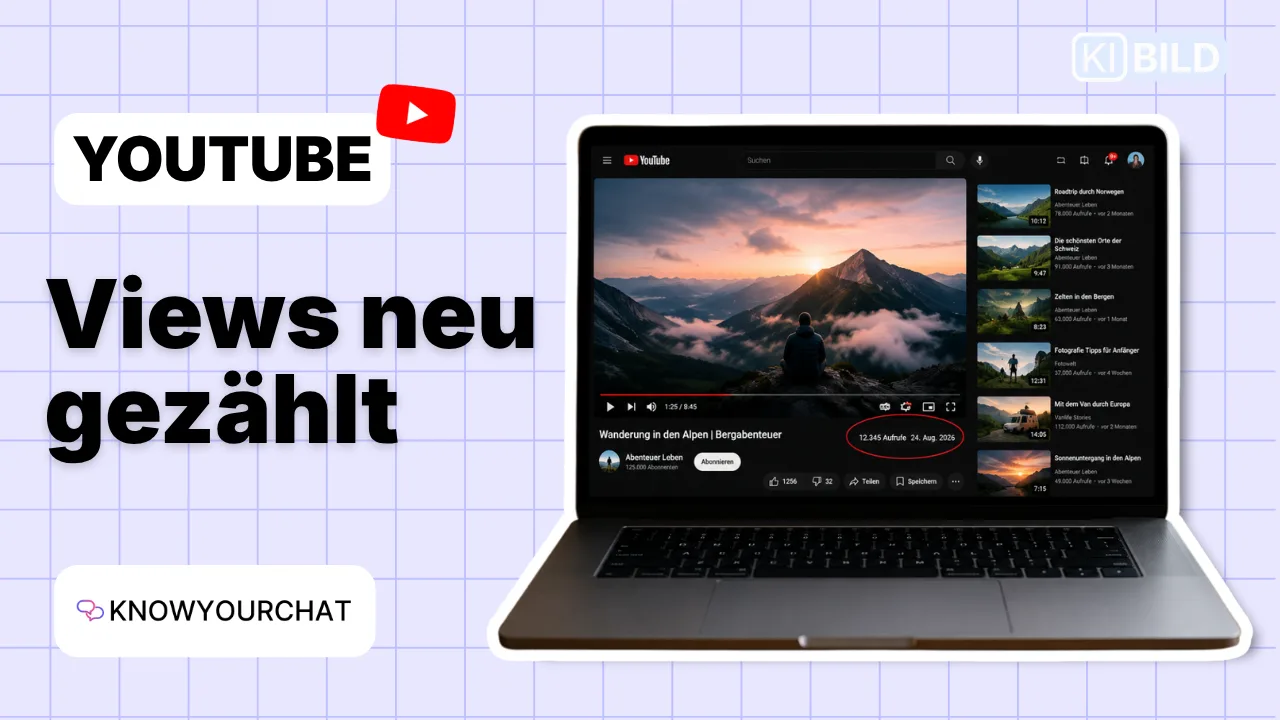

Facts first: Since August 24, 2026, YouTube counts a public view the moment a video starts playing. The first frame is enough. The new counting method applies worldwide to classic YouTube videos, Shorts, podcasts and livestreams. As a result, publicly visible view counts may rise faster. The new view counting does not change anything about monetization or the eligibility requirements for the YouTube Partner Program.
If you regularly track the view counts of your YouTube channel, you may have noticed a change since August 24. Videos may be collecting views faster than before.
Behind this is a fundamental change to one of the platform's best-known metrics.
YouTube is standardizing how it measures its different video formats. Going forward, a public view describes more closely how often a video was started. Whether someone actually kept watching afterwards can be assessed through other metrics.
For creators and businesses, one question becomes more important:
What does a YouTube view in 2026 actually still tell you?
How has YouTube counted views since August 24, 2026?
At first, the new rule is surprisingly simple. As soon as a video starts playing, a view is counted.
This is how YouTube puts it in its official announcement: counting starts "from the very first frame", that is, with the first frame of the video. This method applies worldwide and across the various video formats.
Affected are:
- classic YouTube videos
- Shorts
- Livestreams
- Podcasts
For Shorts, however, this logic isn't entirely new. YouTube had already adjusted the public view count there previously. With the change on August 24, this principle is now standardized across the platform. Among other reasons, YouTube justifies the decision by wanting to make the different measurement methods between formats easier to understand.
For creators, this results in a more consistent public metric.
Will YouTube views now rise automatically?
YouTube itself expects that creators may see their overall view counts grow faster going forward. However, this doesn't automatically mean that a channel suddenly reaches more people or that its videos are watched longer.
A simple example: a video starts for 10,000 people. Some of them decide within the first few seconds to keep watching. Others quickly drop off again.
These starts can now be included in the public view count. To assess actual interest, what happens after the start is what matters. That's exactly why YouTube isn't simply dropping the previous perspective without replacement.
What are "engaged views" on YouTube?
One of the most important metrics after the switch is called engaged views.
YouTube describes them as the number of plays in which viewers kept watching after the first few seconds. Repeats or loops are not included. The original view metric is therefore essentially preserved, but gets a different name and a different place.
Creators can find engaged views in the Advanced Mode of YouTube Analytics.
This creates two different perspectives: Views primarily show a video's exposure or starts.
Engaged views show how often people actually kept watching after the first few seconds.
This distinction will be particularly interesting for analyzing a video in the future.
Why 100,000 views will no longer mean 100,000 interested viewers
The public view count has always been just one metric among many. The new counting method makes this limitation even more obvious.
A video with 100,000 views may have been started very often. The number alone, however, reveals little about how long people stayed.
For businesses, it's therefore important to look beyond the public number.
YouTube Analytics provides the following metrics, among others:
Engaged views: How often did people keep watching after the first few seconds?
Watch time: How much time did viewers spend with the video in total?
Average view duration: How long do people keep watching on average?
Average percentage viewed: What share of a video was watched on average?
Audience retention: At which points do viewers stay engaged, and when do they drop off?
Impressions and click-through rate: How often was the thumbnail shown, and how often did that impression lead to a view?
YouTube continues to provide these metrics in Analytics.
Audience retention in particular can offer insights that a plain view count doesn't show. If many viewers drop off within the first few seconds, for example, it's worth taking a closer look at the intro, the topic or the expectations set.
What does the change mean for YouTube Shorts?
The situation is a little different for Shorts. YouTube had already adjusted the public counting method there previously. For Shorts, the platform also describes the metric "Stayed to watch". It shows the percentage of cases in which viewers kept watching beyond the first few seconds of a Short.
Here, too, the distinction between a start and actual interest becomes visible.
A Short can get a lot of views. But if a large share of viewers swipe away immediately, the public view count only tells part of the story.
For businesses publishing Shorts, it's therefore worth not just comparing the biggest view counts.
More interesting questions include: Which topics keep people watching? Which intros work? Which Shorts gain subscribers? And which content is started often but quickly loses viewers again?
Is YouTube monetization changing?
YouTube gives a clear answer here:
No.
The new public view count changes neither creators' earnings nor, in principle, the requirements for joining the YouTube Partner Program.
For earnings, YouTube continues to use "Engaged Shorts views" and "Engaged Watch Hours". For the Partner Program eligibility requirements, YouTube will now refer to "qualified Shorts views" and "qualified watch hours".
An increase in publicly visible views therefore doesn't automatically mean that the monetization-relevant numbers rise in the same proportion. This distinction is particularly important when channels compare their performance before and after August 24.
Will YouTube channels suddenly look bigger now?
At least in terms of public perception, the new counting method can have an effect.
YouTube itself points out that creators will probably see their overall view counts rise faster going forward. The platform explicitly names presenting one's own reach to brands and sponsors as a possible advantage of the standardized measurement.
An analysis by the creator marketing company Agentio gives a first impression of how large the difference could be. The company examined 35,800 long-form videos and estimates that public view counts under the new method could be around 30 percent higher than engaged views.
However, this figure shouldn't be understood as a general rule. It comes from an external study and can vary significantly depending on the channel, audience and content.
For comparisons, it therefore becomes important which metric is being looked at.
What does the new view count mean for businesses?
For social media teams, the change is above all a good opportunity to review their own KPIs.
A large view count looks good and shows that a piece of content was started often. On its own, however, it's hardly enough to evaluate a content strategy.
Suppose two videos each reach 50,000 views.
Video A loses a large share of viewers right after the intro.
Video B holds viewers significantly longer, is watched to the end more often and leads to new subscribers.
At first glance, both videos stand at 50,000 views. For further content planning, however, they deliver completely different insights.
That's exactly why businesses should look at their YouTube performance across several metrics.
Evaluate your YouTube performance with Matelify
This development fits a core idea of the Mates from Matelify: individual metrics rarely tell the whole story of a social media post.
The Mates support you through the entire social media content process, from strategy and ideation to creation, planning and evaluation. Instead of focusing solely on a big view count, various performance metrics can help you understand which topics and formats actually resonate.
These insights can then feed back into content planning. A topic that keeps people watching for a long time can be developed further, for example. For a video with many starts and early drop-offs, on the other hand, the intro can be reviewed.
This turns analytics into more than a collection of numbers: the results of past content provide pointers for the next post.
Start Matelify for free here now and meet the Mates right away.
Conclusion: views now measure the start more than anything
Since August 24, 2026, a YouTube view has a slightly different meaning. A view is counted as soon as a video starts playing. As a result, publicly visible view counts can grow faster.
For creators and businesses, this by no means makes the view count useless. It just needs to be put into the right context.
If you want to know whether a video actually works, you have to look further: engaged views, watch time, view duration and audience retention provide information about what happens after the first frame.