
Facts first: wired headphones are back. You see them on the train, on the street and strikingly often in social media videos. What initially looked like a small retro aesthetic can now also be seen in the sales figures. After five years of declining sales, revenue from wired headphones grew again by three percent in 2025. In the second half of the year, the increase was ten percent, and in the first six weeks of 2026 it was as much as 20 percent compared to the same period the year before.
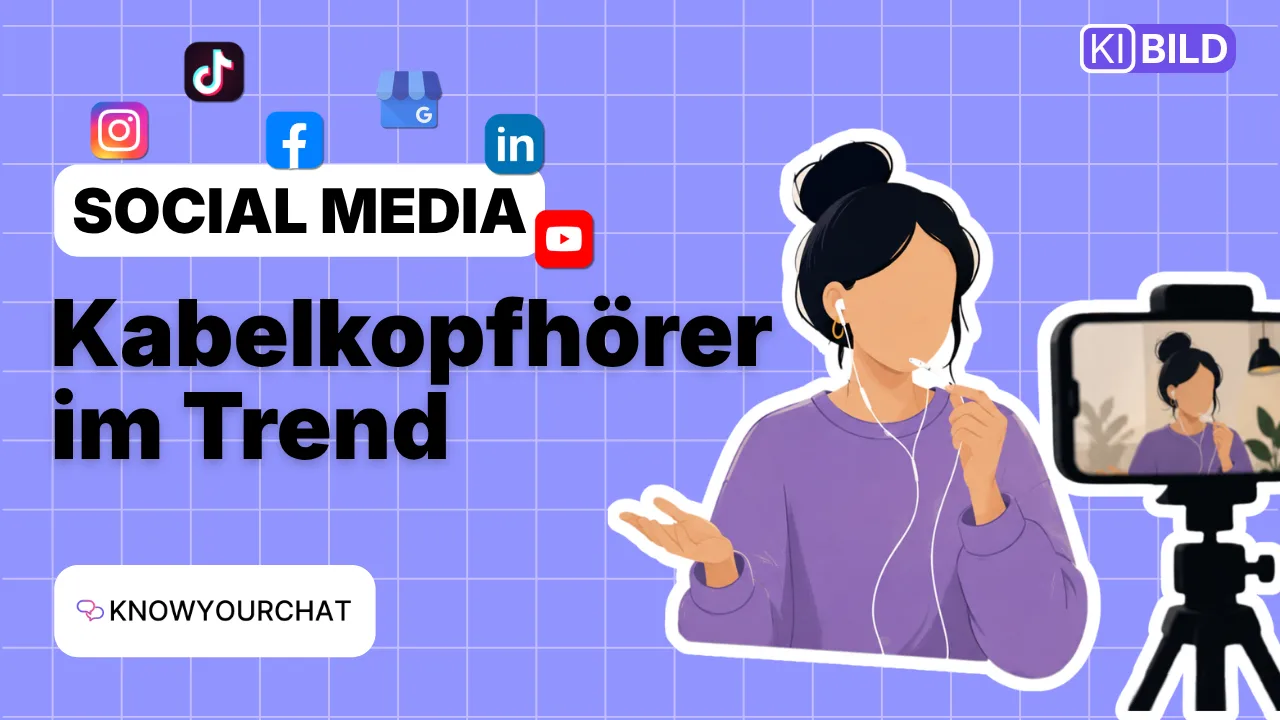
The trend gets even more interesting when you look at Instagram and TikTok. There, wired headphones don't just show up for listening to music. Creators hold the small mic on the cable in their hand and speak into it as if it were a mini handheld microphone.
Why are people voluntarily going back to a technology whose cables we were so desperate to get rid of a few years ago?
Wired headphones really are trending again
After five years of falling sales, market research company Circana observed growth in wired headphones again for the first time in 2025. The trend accelerated toward the end of the year and continued into early 2026. At the same time, according to Circana, sales of simple digital cameras rose by 93 percent in 2025.
Both developments fit together surprisingly well. Technology that was considered outdated just a few years ago is becoming interesting again. Old digital cameras, vinyl records, retro consoles and other physical technologies are finding new audiences. Wired headphones are a particularly visible example.
Search interest is picking up, too. In May 2026, worldwide Google search interest for a common English search term related to wired in-ear headphones reached its highest level in five years, according to Inc.
Why are wired headphones popular again?
Part of the explanation lies in their simplicity. There's no battery to charge. There's no charging case. No pairing is necessary. As long as you have the right cable or the right port, you can use the headphones.
Then there's the price. Circana puts the average selling price of wired headphones in 2025 at around 13 US dollars. For Bluetooth models, it was around 99 US dollars.
The practical benefits alone don't explain why the cable is suddenly becoming a visible trend, though. This is where nostalgia comes in.
The cable is a reminder of the 2000s and early 2010s. An era whose aesthetic is currently being revived in fashion, music and social media. Current reports on the comeback describe, especially among younger people, a mix of retro aesthetics, a low price, no battery stress and a desire for simpler technology.
The cable thus goes from technical drawback to part of the look.
When the headphone mic becomes a handheld microphone
On social media, the trend takes on a second layer. More and more often, you see videos in which the mic of wired headphones is deliberately held in the hand. The cable hangs visibly through the frame while the person speaks directly into the small mic.
Visually, this is reminiscent of a street interview or a presenter. At the same time, the recording feels much more improvised than a video with a professional wireless mic.
That fits the current social media aesthetic. The clip doesn't necessarily need to look as if someone spent half an hour setting up lights, camera and sound before recording. The small headphone mic says: phone out, mic in hand and go.
Is the mic on wired headphones really that good?
An important distinction is worth making here. Wired headphones don't automatically have a better microphone than wireless headphones or a professional external microphone.
For speech, however, a wired connection can have advantages. Tests by RTINGS point out that Bluetooth can limit the available frequency range for headset microphones. Good wired headsets with a properly positioned microphone can therefore achieve higher recording quality.
For social media, though, something else is crucial: the position of the microphone.
The small mic on the cable is closer to your voice than a smartphone that might be standing on a tripod a meter away. As a result, speech can be captured more directly.
However, “the closer, the better” doesn't apply. SoundGuys points out that in-line microphones are usually designed for a certain distance. Held directly in front of the mouth, some models can clip and even make speech less intelligible.
For creators, this means: try it out and make a short test recording. The in-line mic doesn't replace a professional microphone. For a spontaneous Reel, though, it can be a surprisingly simple solution.
Why do creators hold the mic in their hand?
Technically, the small mic could just hang on the cable. But creators deliberately holding it in their hand serves another purpose.
It changes the visual language.
Viewers immediately recognize: someone is talking directly to me. The mic becomes a visual signal for conversation, interview or personal address. At the same time, something very practical happens: the hands have a job.
If you're not used to being in front of a camera, you know the situation. What do you do with your hands? Cross them? Gesture? Just let them hang? An object creates a natural point of reference. One hand holds the mic while the other stays free for gestures.
We know this principle from classic interviews and presenting. Social media simply translates it into a more informal form.
The psychological factor: having something in your hand
It's precisely this haptic factor that makes the trend even more interesting.
Touch can influence our perception and experience. Research on haptic stimuli shows, for example, that targeted tactile stimulation can affect physiological arousal and subjectively perceived tension before public speaking.
However, this does not mean that a headphone mic automatically reduces nervousness in front of the camera. There's no robust study on that.
The practical observation is still interesting: a physical object gives your hands a fixed position. Instead of thinking about how you're standing in front of the camera, you hold on to something and can focus on speaking.
The mic is therefore both a recording device and a prop.
Especially for people who don't have much experience in front of the camera yet, this kind of reference point can make the recording situation feel more natural.
What the trend reveals about social media content
The comeback of wired headphones therefore tells a bigger story. Social media production is becoming more and more technically powerful. Smartphones film in high resolution, professional wireless mics have become compact and AI can now take over parts of post-production.
At the same time, formats that look deliberately simple are working. That's not a contradiction.
Professional content doesn't necessarily have to look elaborately produced.
That's an important insight for companies. If camera, tripod, lights and microphone have to be set up for every short video, the hurdle for regular video content goes up.
Simpler formats can help get people from your company in front of the camera more often.
Of course, the technical quality should still be right. Speech has to be intelligible and the image usable. But perfection isn't a requirement for a good Reel.
Nostalgia meets social media
Wired headphones thus combine several developments: they're cheap, don't need a battery, are easy to use and at the same time fit the current retro aesthetic.
That's exactly why we find the trend so exciting.
Because wired headphones aren't the only piece of the past making a comeback right now. Old digital cameras, earlier internet aesthetics and the social media culture of the 2010s are being rediscovered, too.
From topic to finished video script with the Mates
The technical recording is only one half, though. Before that, you need to clarify what the video is actually supposed to say. This is exactly where the Mates from Matelify can help.
Starting from a topic or an initial idea, you can develop a video script for social media together. This includes, for example, a fitting intro, the core message, the key bullet points and a meaningful ending. The target audience, tone of voice and strategic direction of your company can also be taken into account.
The script doesn't have to be a text that you then read out word for word in front of the camera. Especially for short social media videos, a clear hook and a few bullet points that the person can follow during the recording are often enough. That makes the path to your video much shorter
Conclusion: sometimes a cable is all you need
The wired headphone trend fits surprisingly well with a development in social media content: good content doesn't necessarily have to be elaborately produced. A clear idea, a prepared script, intelligible audio and a smartphone can already be enough for a short video.
The Mates from Matelify can help you prepare the content. For the recording itself, you may then need less equipment than many companies assume. Want to get to know the Mates from Matelify? Then sign up here for free now.