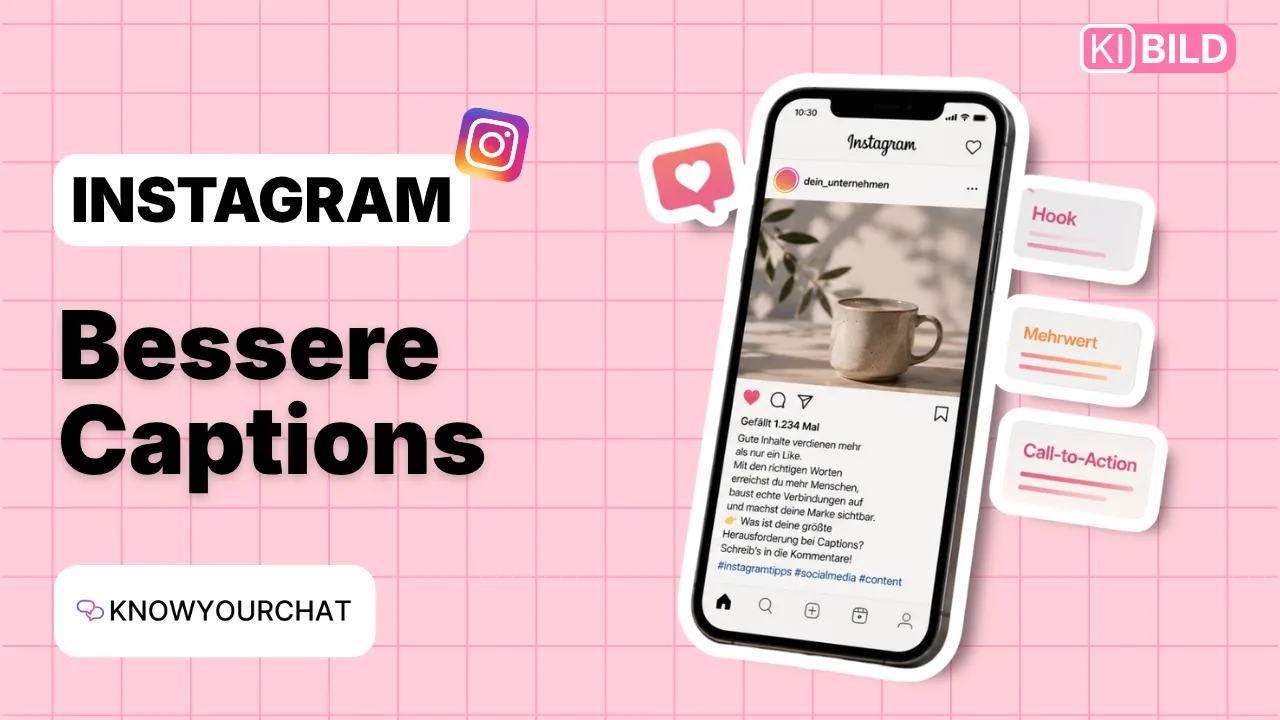

Facts first: A good Instagram caption is more than the text below an image or Reel. It provides context, can continue a story, share knowledge and prompt people to respond. At the same time, the terms you use play a role in how discoverable a post is. For businesses, there is another aspect: public posts and Reels from certain professional accounts can also be indexed by search engines like Google and Bing.
A good image or the opening of a Reel makes someone stop scrolling. The caption can then explain, add context and fill in the gaps.
Instagram itself has addressed the importance of captions in a post. The Instagram post on captions mentions, among other things, a strong opening, storytelling and value, a call to action, relevant keywords and an easy-to-read structure.
For businesses, it's therefore worth not writing the caption just a few seconds before publishing.
What is an Instagram caption?
A caption is the accompanying text of an Instagram post. It can consist of a single sentence or tell in more detail what's behind a photo, Reel or carousel.
There's no one-size-fits-all answer to how long a good Instagram caption should be. A photo from an event may only need a few explanatory sentences. For a Reel, the caption can provide additional information that didn't fit into the video. A professional carousel can be complemented with an example or further thoughts.
The more important question is therefore:
What information does someone need in addition to the actual post?
If you've already explained five tips in detail in a carousel, you don't need to repeat them in the caption. Instead, you can add background, experiences or a follow-up question.
1. The first lines must make the topic clear
The Instagram post recommends grabbing attention in the very first line. The idea behind it is simple: in the feed, only part of the text is shown at first. So the first words need to give people a reason to keep reading.
That doesn't mean every caption has to start with the most dramatic hook possible.
Phrases like "You need to know this" or "90 percent of businesses make this mistake" quickly lose their effect when every post starts the same way.
Being specific is often better.
Instead of:
"We didn't see that coming ourselves."
the opening could be, for example:
"These are the three mistakes we see most often in social media planning."
The reader knows immediately what it's about. At the same time, the post's key terms are named right away.
2. Tell a story or deliver real value
The underlying Instagram post names two possible directions for good captions: telling a story that creates a connection, or providing useful information that people want to save or share.
Businesses in particular have far more material for this than is visible at first glance.
What went wrong on a project? Which question do customers ask most often? What did the team learn from a workshop? Which misconception does the sales team run into again and again?
Information like this is often more interesting than generic marketing messages.
A trades business, for example, wouldn't just write that a new system was installed, but explain which on-site challenge had to be solved. A software company can use a customer question to show how a specific feature is used.
The caption thus extends the story of the actual content.
3. Use relevant keywords in your Instagram caption
Captions are now also relevant for social SEO. If you'd like to read up on social SEO again, our blog article is the right place to start.
The original post explicitly recommends weaving relevant, descriptive keywords naturally into the text. The basic idea makes sense: if you clearly describe what a post is about, you create additional topical signals.
For businesses, this primarily means using the language of their target audience.
A café in Munich could, for example, talk about "breakfast in Munich" if that's exactly what the post is about. A software company can use terms like "social media planning for businesses" if the content addresses that question.
Keyword stuffing isn't necessary for this.
A caption shouldn't become a string of search terms. Good social SEO copy remains, first and foremost, copy for people.
4. Instagram content can also show up on Google
Social SEO no longer necessarily ends within Instagram.
Meta explains in its Help Center that search engines may index public photos and videos from posts and Reels if certain conditions are met. These include, among others, that the account is public and professional and that the account holder is at least 18 years old. Eligible content published since January 1, 2020 may be affected. Users can turn off indexing in their settings.
In its information on professional accounts, Instagram also points out that photos and videos can appear in search engine results, allowing people outside Instagram to discover content as well.
For businesses, this is another reason to structure posts with a clear topic.
A good caption therefore shouldn't be written for some supposed algorithm. It should clearly state what it's about.
5. Keep longer captions easy to read
Instagram is consumed on a comparatively small screen. A long, unstructured block of text makes reading harder. The Instagram post therefore recommends line breaks, short paragraphs and, if needed, emojis.
This is especially useful for longer captions. One thought per paragraph provides orientation. Subheadings or bullet points can also help with explanatory content.
Emojis can support the structure, but they should fit the way the business communicates. They don't replace clear text. The same goes for length: as detailed as necessary, as concise as possible.
A complicated explanation can be longer. For a simple event announcement, three sentences may be enough.
6. End the caption with a fitting call to action
What should someone do after reading your post? A call to action, or CTA for short, answers that question. It can be a question that invites comments. For an informative post, it can make sense to suggest saving it. For an event, the next step might be signing up.
A few examples:
"What's your experience with this?"
"Save this overview for your next content planning session."
"You'll find all the event details via the link in our bio."
Not every post necessarily needs a CTA, though. An artificial prompt can feel just as out of place as a caption with no clear ending. The next step should follow naturally from the content.
7. The caption has to sound like your business
With generative AI, you can now create numerous caption drafts within seconds. That makes your own tone of voice all the more important. A local trades business speaks differently than a university. A young fashion brand differently than a government agency.
Good captions take these differences into account. This includes word choice, sentence length, humor, technical terms, form of address and how assertively a business communicates.
Your own experiences and concrete details also help avoid interchangeable copy. AI can create a draft. The information from your business turns it into your own post.
Creating Instagram captions with Cleo
This is exactly the process that Cleo, one of the Matelify Mates, supports.
Cleo helps you create social media content, taking into account your business's tone of voice, target audience and the respective channel. For an Instagram caption, she can develop a fitting opening, structure the content and naturally integrate relevant terms into the text.
This is especially helpful when you regularly create content for different platforms. A LinkedIn post works differently in terms of language than an Instagram caption. Cleo can adapt the content for each channel accordingly.
People nevertheless remain an important part of the process. They know the experiences behind a project, check professional statements and add the details that make a post unmistakable.
Checklist for your next Instagram caption
Six questions help before publishing:
- Do the first lines make clear what it's about?
- Does the caption complement the visual content?
- Does it deliver a story, information or some other value?
- Am I using relevant keywords naturally in the text?
- Is the caption easy to read on a smartphone?
- Does a call to action fit – and if so, which one?
If you consider these points while creating your content, you won't have to improvise the caption shortly before publishing.
Conclusion: Good Instagram captions are part of your content strategy
An Instagram caption isn't an afterthought to the actual post. It can provide context, share knowledge, tell stories and spark interactions.
Then there's search. Instagram content can be found within the platform by its topics, and eligible public content from professional accounts can also appear in external search engines.
For businesses, it's therefore worth thinking about captions as early as the planning stage of a post. The image, carousel or Reel grabs attention. The caption provides the context that completes the post.
Cleo, one of the Matelify Mates, helps you turn an idea into fitting copy, include relevant terms and stay true to your business's tone of voice. Want to get to know the Matelify Mates? Sign up here for free.