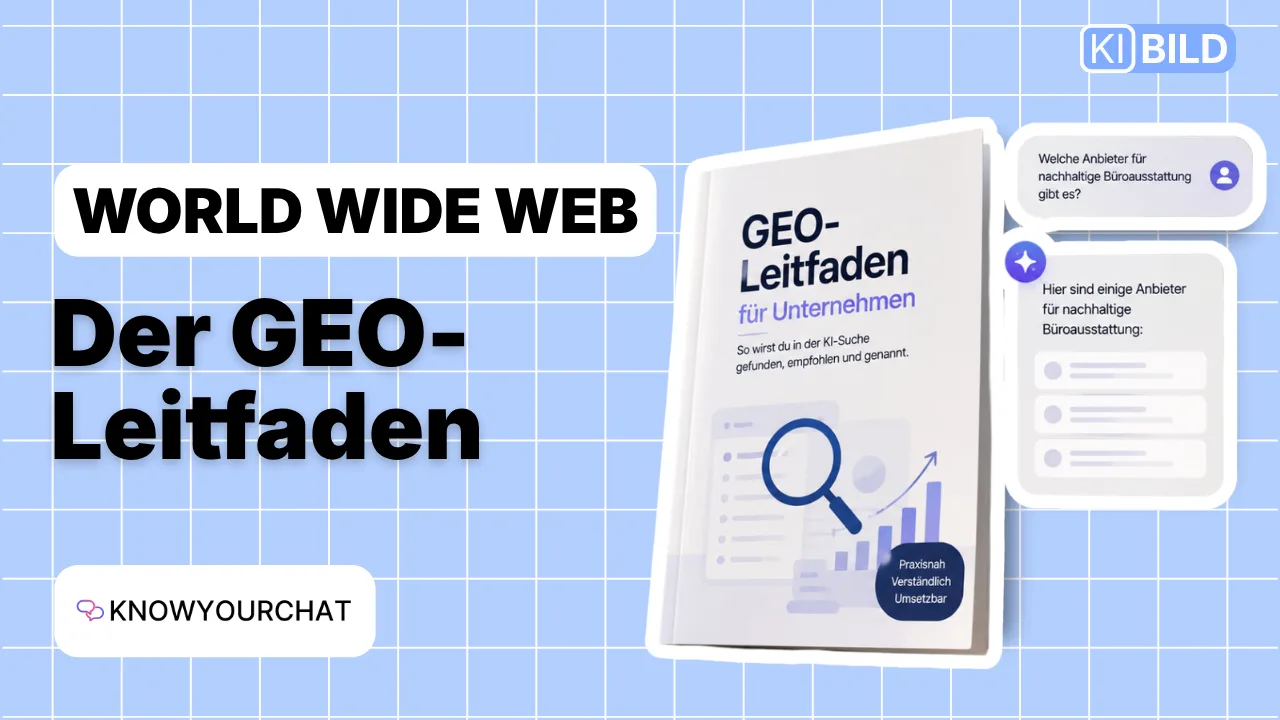

Facts first: Google already shows AI Overviews for around 20 percent of the search terms studied in Germany. According to a SISTRIX analysis, when such an AI summary appears, the average click-through rate for position 1 drops from 27 to 11 percent. For German websites, SISTRIX estimates the resulting loss at around 265 million organic clicks per month.
This changes the job of search engine optimization. A good ranking on Google remains valuable. But another question is becoming increasingly important:
How does a business manage to appear as a trustworthy source in answers from ChatGPT, Gemini, Google AI Overviews and other AI systems?
This is the question addressed by Generative Engine Optimization, or GEO for short.
What does GEO mean?
Generative Engine Optimization (GEO) describes measures intended to make content easier to find, understand and cite for generative search and answer systems.
The term was coined in a 2023 research paper. In it, researchers examined how the visibility of sources within generated answers can be improved. In their experimental setup, individual optimization measures increased visibility by up to 40 percent. However, more recent research urges caution: so far, such results cannot be reliably transferred to all systems or to the organic discoverability of a website. GEO is a young field whose methods and metrics are still evolving.
For businesses, GEO is therefore best understood as an extension of existing content and SEO work. Content should still be found in classic search results. At the same time, it should be so reliable and clearly structured that AI systems can take it into account for their answers.
Do GEO and SEO belong together?
SEO is by no means losing its importance because of AI search. Google emphasizes in its current guidance that the familiar SEO fundamentals continue to apply to AI Overviews and AI Mode. These include a technically accessible website, helpful content, internal linking and a good user experience. Google's generative search features draw on content from the regular search index and on the existing ranking and quality systems.
Put simply, the relationship can be described like this:
SEO supports a website's discoverability in search engines.
GEO additionally looks at how content appears in generated answers, is cited, or is used for recommendations.
A technically flawed website that can barely be indexed will also struggle in AI search. GEO therefore starts with solid SEO work.
Why do good rankings guarantee fewer clicks today?
AI Overviews already answer many informational questions directly on the search results page. According to SISTRIX, for queries with such an overview, the share of searches that lead to any click at all dropped from an average of 57 to 33 percent.
As a result, a ranking can still generate high visibility without bringing in the same number of website visits as before. Businesses should therefore evaluate their SEO performance more broadly.
Beyond rankings and clicks, other questions become important:
- Is your own brand mentioned in AI answers?
- Does the business appear as a source or recommendation?
- In what context is it mentioned?
- Which pages are linked?
- Do these touchpoints lead to qualified inquiries?
Google now provides website owners with a dedicated report on visibility in generative search features in Search Console. There, impressions in AI Overviews, AI Mode and generative features in Discover can be viewed separately.
What content is valuable for AI search?
A language model can summarize general definitions and superficial guides very easily. The hundredth article titled "What is social media?" therefore offers little that expands on an answer that already exists.
Content with real substance is more interesting:
- concrete experience from projects,
- case studies with a traceable approach,
- your own data and observations,
- industry-specific examples,
- clearly explained work processes,
- statements from recognized experts,
- decision aids for specific situations.
In this context, Google speaks of unique, valuable, non-commodity content: content should offer value of its own that goes beyond generally available information. Mass-publishing AI-generated pages without added value can violate Google's policies on "scaled content abuse".
Seven fundamentals for better visibility in AI search
1. Answer one specific question per page
Every page should have a clear focus. An article about GEO can explain what Generative Engine Optimization is and how businesses can implement first measures. In-depth keyword research, technical SEO and link building deserve their own articles.
This separation makes it easier for readers and search systems to categorize the content.
2. Deliver the most important answer early
Long introductions delay the information someone was looking for. A short summary at the beginning helps people find their way and gives AI systems a clearly defined passage.
The facts block at the beginning of this article does exactly that: it names the development, puts it into context and leads to the core question.
3. Make your own expertise visible
Claimed expertise is hardly enough. Readers and search systems need verifiable signals.
Suitable examples include:
- documented case studies,
- concrete results,
- screenshots or examples,
- information on methodology,
- author profiles,
- proven hands-on experience,
- sources for figures and legal statements.
This makes an article verifiable and sets it apart from generic summaries.
4. Back up statements with reliable sources
Generative systems often build their answers from multiple sources. At the same time, recent studies show that the domains used can differ considerably depending on the system, language and phrasing of the query. Mentions on recognized third-party sites play an important role here.
Citing sources also strengthens readers' trust. Figures should point to the original study, legal statements to official texts, and technical recommendations to the provider's documentation wherever possible.
5. Structure content clearly
Precise subheadings, short explanations, tables, checklists and sensible FAQ sections make a text easier to use.
This is about readability. Google explicitly warns against supposed GEO hacks such as artificial "content chunking" or special files created only for AI systems. An llms.txt file is also not required for inclusion in Google's generative search features.
6. Present the brand consistently across channels
Your website, LinkedIn presence, industry directories, trade media and social media channels should convey the same core messages. Inconsistent service descriptions, outdated company information or shifting positioning make clear attribution more difficult.
This consistency also supports the mere-exposure effect: repeated, coherent encounters with a brand increase its familiarity. For businesses, this means clearly owning their areas of expertise across several suitable touchpoints.
7. Update articles regularly
Outdated figures, features that are no longer available and obsolete recommendations reduce an article's reliability. Content with time-sensitive statements should have a visible publication or update date and be reviewed regularly.
An update takes more than a new date. It should genuinely bring sources, examples, screenshots and recommendations up to date.
Does GEO need special structured data?
Structured data can help search engines understand certain content and entities on a page. It also enables classic displays such as product, event or company information.
However, there is no special GEO markup for visibility in Google AI Overviews or AI Mode. Google explicitly states that structured data is not an additional requirement for its generative search features. The information must also match the visible content of the page.
For SMEs, the recommendation therefore remains pragmatic: implement useful structured data cleanly, without attributing an effect to it that is currently not proven.
What role do social media and the community play?
GEO doesn't take place exclusively on your own website. Questions from comments, direct messages, sales conversations or customer service show very precisely what information people need.
If a question comes up regularly, it is often well suited for a well-researched blog article, an FAQ, a video or a detailed LinkedIn article. Everyday conversations thus produce content that addresses real needs.
An example:
Several customers ask whether AI-generated social media texts need to be labeled under the EU AI Act. This can lead to a foundational article. A second article answers concrete practical cases. Short social media posts pick up individual questions and link to the detailed explanation.
This way, a coherent topic cluster grows. The pieces of content reinforce each other, cover different search intents and demonstrate subject-matter depth.
How Matelify supports GEO-relevant content
Matelify is not a tool for technical GEO optimization and does not promise placement in ChatGPT or Google AI Overviews.
The same applies to GEO: good content rarely happens by chance. This is exactly where the Mates from Matelify support you. They help you identify topics, prepare content in a structured way, plan publications and evaluate results. Step by step, this creates high-quality content that offers people real value and at the same time lays the foundation for better visibility in search engines and AI systems.
The Mates' most important contribution lies in how everything works together: a customer question is recognized, evaluated strategically, developed into content, planned, published and refined based on the reactions.
GEO checklist for SMEs
Before publishing a new expert article, these questions help:
- Does the page answer a clearly recognizable main question?
- Does the central answer appear early in the text?
- Does the article contain your own experience, data or concrete examples?
- Are figures and expert information backed by reputable sources?
- Do the headings precisely describe each section?
- Is the text technically accessible and sensibly linked internally?
- Do the statements match your communication on other channels?
- Is there a publication or update date?
- Does the article lead to a sensible next action?
Conclusion:
Generative Engine Optimization is not a collection of guaranteed tricks. Nobody can guarantee that a particular text will be cited in an AI answer. The systems change quickly, sometimes respond differently to the same question and use changing sources.
The most reliable foundation remains a technically clean website with original, understandable and verifiable content. GEO extends this work with the perspective of generative search: Can a system clearly grasp the statement? Does the source seem trustworthy? Does it deliver something other pages don't offer?
Businesses that answer real questions from their target audience and consistently make their expertise visible create a solid foundation for both classic search engines and AI search.
Develop content from real questions your target audience asks
With Matelify, you can pass questions, observations and ideas to the Mates by text or voice. Together, they turn into strategically fitting topics and content in your company's brand voice. A human then reviews, adds to and decides on publication.
Sign up for Matelify for free here now and get to know the Mates.