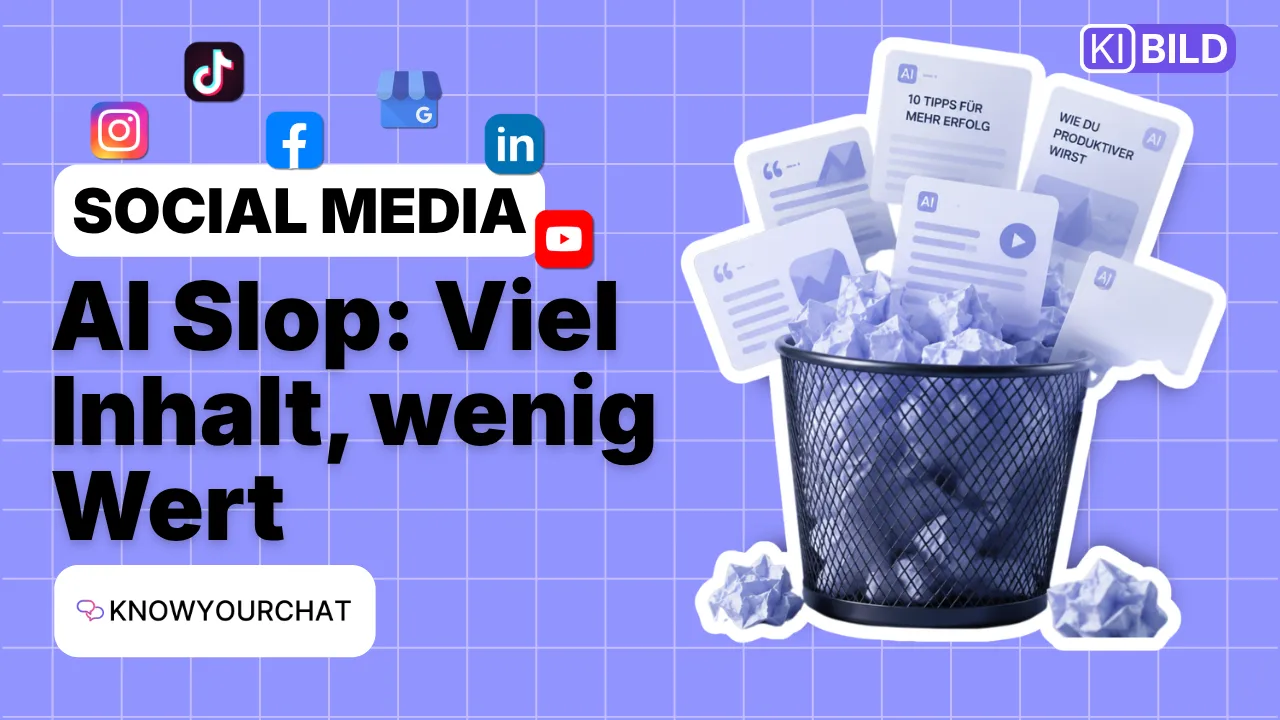

Facts first: Creating content has never been easier. With just a few prompts, blog articles, social media posts, images or videos can be produced within minutes. At the same time, a new problem is growing: more and more content feels interchangeable, superficial and lacking its own perspective. This trend now has its own name: AI slop. Platforms like LinkedIn are already responding: they let users specifically report this kind of content. At the same time, LinkedIn emphasizes that artificial intelligence is welcome as long as posts reflect your own voice, experience and perspective.
AI makes content easier, but not automatically better
Open your LinkedIn feed today. It probably won't take five minutes before you come across several posts that read surprisingly alike. They start with a provocative statement. Then comes a personal story. After that, three to five bullet points. At the end, there's a question to the community. The structure works. The only problem: it's now being used thousands of times over.
Many of these posts were created with artificial intelligence, or at least heavily shaped by it. But that alone isn't the real problem.
It becomes a problem when content barely contains any personal experience, personal opinion or real added value anymore. That's exactly what the term AI slop has come to describe.
What is AI slop?
AI slop describes content that's created quickly, and often in large volumes, with the help of artificial intelligence, yet delivers hardly any new insights. This can be text. But just as much images, videos or comments. At first glance, it looks professional. On closer reading, however, little sticks. Often what's missing is:
- a personal experience,
- a well-reasoned opinion,
- a concrete example,
- a reliable source,
- or a new idea.
The content isn't necessarily wrong. It's simply interchangeable. Because when everyone uses the same prompts and publishes similar content, you get more content, but not more knowledge.
Why AI slop is suddenly being discussed everywhere
The term AI slop is gaining importance right now because far more people use artificial intelligence today than just a few years ago. As a result, enormous amounts of new content are created every day. Many of these pieces, however, are very similar and offer hardly any new insights or personal experience.
At the same time, readers' expectations are rising. If you consume dozens of posts a day, you quickly notice when content merely repeats familiar statements. Platforms are watching this trend too.
LinkedIn recently introduced a new option to report posts directly as AI slop. This lets users give targeted feedback when they perceive content as generic or unhelpful.
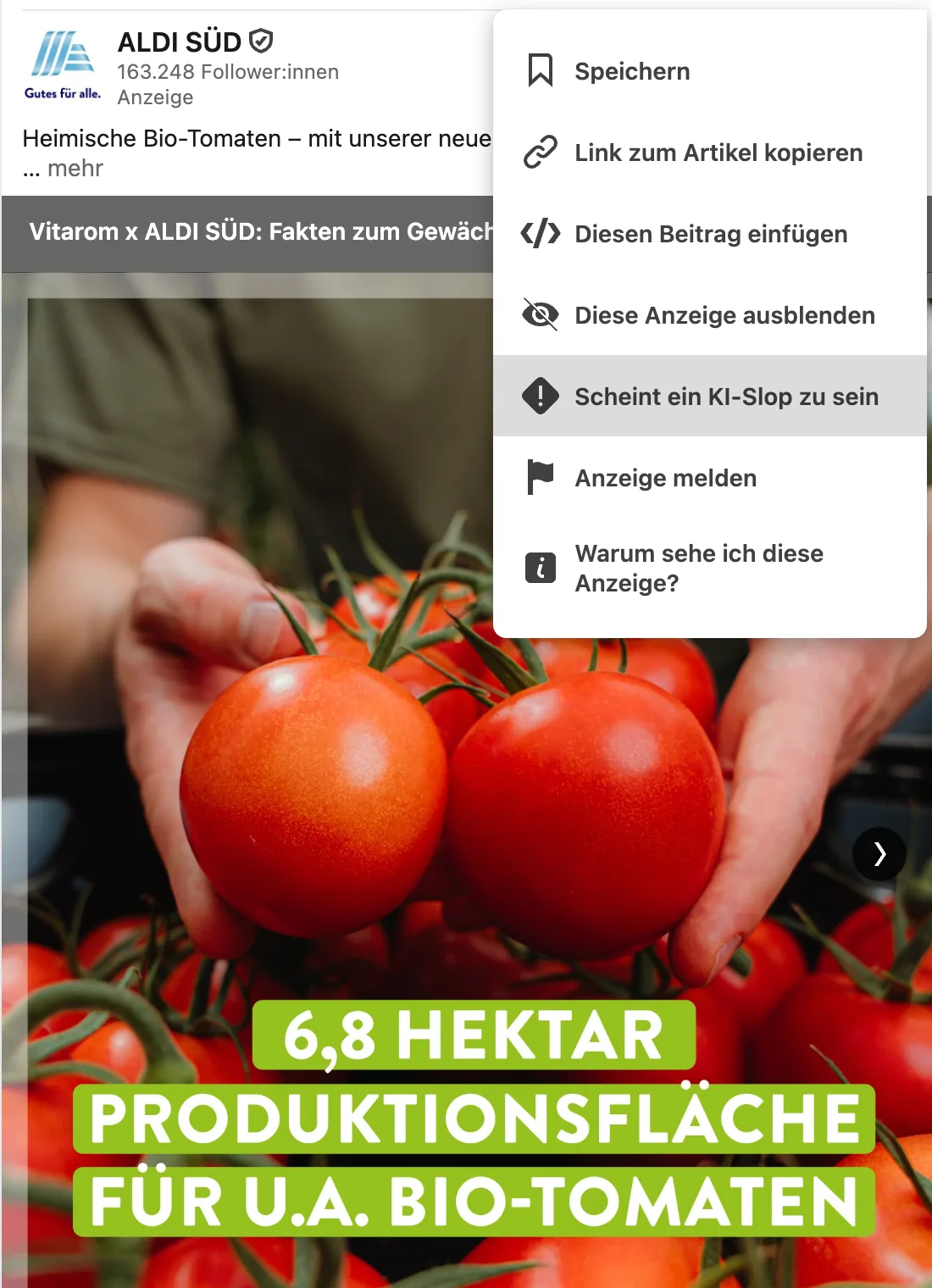
The new reporting feature makes it clear what LinkedIn is after: posts should offer people real value. Interchangeable content without its own perspective or relatable experience is therefore increasingly coming under scrutiny.
How do you recognize AI slop?
1. The post could have come from any company
If a post reads so generically that you can't tell the industry or the company, it's usually missing a personal perspective. Good content shows why a company has something to say on a topic.
2. Only obvious statements are made
"Content is important." "Customers want trust." "AI is changing marketing." All of these statements are true.
But they hardly help readers if no context or concrete recommendation follows.
3. Personal experiences are missing
People are interested in experiences. What worked? What didn't work? What did you learn from a project? What mistakes were made?
This is exactly the kind of information artificial intelligence can't generate on its own. It only comes from people.
4. There are no sources
If you cite numbers, you should back them up. If you mention studies, you should link to them. If you make claims, you should explain what they're based on.
Especially in the age of generative AI, reliable sources are more important than ever. They build trust. With readers. And with search engines, too.
5. Every paragraph sounds the same
Many AI-generated texts follow similar patterns. Short intro. Three bullet points. A conclusion. A question to the community.
This structure isn't fundamentally wrong. But when it's used identically over and over again, it quickly gives the impression of mass production.
Good content surprises. It tells stories. It alternates between facts, examples and personal experiences.
Can AI slop hurt my company?
Many companies see artificial intelligence primarily as a way to publish content faster. In the short term, that often even works. In the long term, however, AI slop can have exactly the opposite effect.
If you keep publishing interchangeable content, you hardly build any trust. Posts get seen, but not saved. They get read, but not recommended. They generate reach, but not recall.
This is especially problematic in B2B. People rarely buy from the company that publishes the most. They often choose the company that demonstrates expertise, shares relatable experiences and builds trust.
That's exactly why quality will matter more than quantity in the future.
How do I avoid AI slop?
The good news: AI slop can be avoided.
AI is an excellent sparring partner. It can develop ideas, structure texts or help create a first draft. But the decisive difference is still made by people.
These seven principles help you create content that stands out from generic AI content.
1. Share your own experiences
A company's biggest advantage can't be generated with a prompt. It's the experience from everyday work. What questions do customers ask again and again? What challenges do you run into regularly? What mistakes have you made and what did you learn from them?
2. Write for people, not for algorithms
A lot of content today is created with the goal of cramming in as many keywords as possible or pleasing the algorithm. In the process, it's often forgotten who's actually supposed to read the post.
A good article answers a specific question. A good LinkedIn post sparks a thought. A good video helps you understand a problem better.
3. Use reliable sources
Especially in the age of artificial intelligence, trust is becoming the most important currency. That's why numbers, studies and legal statements should always be verifiable.
Citing reputable sources doesn't just show expertise. It also lets readers verify statements for themselves. That creates credibility.
4. Tell concrete stories
People rarely remember definitions. They remember stories. So don't just describe that something worked. Explain how you went about it. What was the starting point? What decision was made? What happened next?
5. Give your brand a voice
Every company communicates differently. That tone should also be reflected in AI-assisted content.
The more personal and recognizable the language, the more strongly a company sticks in people's minds.
6. Use AI as support - not as autopilot
Artificial intelligence should make work easier, not take over responsibility.
If you review, add to and question every draft, you benefit from the speed of modern AI without sacrificing quality.
7. Ask yourself a simple question
Before you publish a post, ask yourself:
Would I save this post if it didn't come from my company?
If the answer is "No", something is probably still missing. A personal experience. An example. A source. Or a new perspective.
What does this mean for Matelify?
That's exactly why we take a different approach at Matelify.
The Mates help structure ideas, identify topics and develop first drafts. They help find the common thread and organize content more efficiently.
The experience, the personality and the expert context, however, still come from the company itself.
Because these are exactly the things that can't be automated. They come from people. That's why we don't see artificial intelligence as a replacement for marketing. But as a tool that helps companies make their knowledge visible.
Conclusion
AI slop happens when content is published without original thoughts, experiences or added value. If you use AI wisely, you can research faster, work in a more structured way and become more creative.
If you rely exclusively on generic drafts, on the other hand, you risk getting lost in the crowd. That's exactly why personality, expertise and authenticity will become even more important in the future.
Because one thing won't change in the years to come either:
AI makes content faster. People make it valuable.
Use AI – but with your own signature
With Matelify, you develop content together with Mates that support you with strategy, ideation and content. You stay in control of tone, messaging and publishing at all times.
The result isn't interchangeable AI copy, but content that fits your company and delivers real value.